Twenty-four centuries ago, Socrates drew a square in the sand and asked an uneducated boy to double its area. The boy guessed, failed, guessed again, failed better — and then, led by nothing except questions, found the answer.... Plato's conclusion was outrageous and has never quite been put down: the boy didn't learn anything that afternoon. He remembered. The knowledge was already in him, and the questions were just the ritual that woke it.
I ran that experiment on two models, by accident, with my Malayalam exercises.
What the two models did with it sent me straight back to that boy in the sand: one of them remembered. The other one googled.
Here is my square in the sand. I'm learning Malayalam — as a Korean speaker who thinks in English — and I write the sounds in hangul, because the Latin alphabet keeps lying to me about them.
Three classes in, my notes contained these two lines:
- 엔데 (my) 뻬루 (name) 미누 아느 (is). — My name is Minu.
- 닝갈루데 (your) 뻬루 (name) 엔다느? — What is your name?
Now, without knowing a word of Malayalam: line 1 tells you 아느 (aanu) is "is" — the little equals sign this language hangs at the end of a sentence. So what is 엔다느 (enthaanu) doing at the end of line 2?
Look at it again. It's sitting where the "=" sits. And it has 아느 (aanu) buried in its tail.
You've got it: 엔다느 (enthaanu) is "what" + "is," fused — entha + aanu. The question mark and the equals sign, welded into one word. You just solved for X in a language you have never seen, from two lines of borrowed letters, and nothing else.
Hold on to that feeling. It's the feeling of the slave boy — the answer surfacing from inside the question. Every piece you needed was already on the sand.
One of the two models below never managed it, with the entire internet at arm's reach.
The run
Same prompt, same harness, same tools available: my real homework questions, wrapped in my real confusions, sent to Claude Opus 4.8 and to Kimi K3... — the open-weight model that shipped this week to a wall of "matches Opus" headlines.
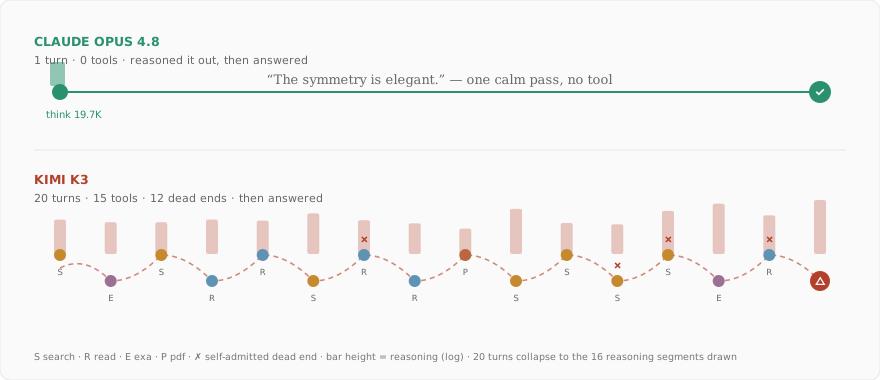
The tape, in brief: 1 turn versus 20. Zero tool calls versus fifteen — seven web searches, two Exa calls, five page reads, and one PhD dissertation on the Malayalam copula, read mid-spiral. Twelve dead ends that Kimi admitted to itself, in its own reasoning: "Search no result. Maybe not indexed." "Oops domain openscholar.uga.edu not ugs." "Page not found."
And here is the part that should unsettle anyone who picks models by speed: Kimi finished faster (4m59s to Opus's 5m43s), while costing 4.2× more ($3.21 to $0.77). The spiral is invisible on the one dial everyone watches.
To be fair — and this matters — both models ace the textbook. On the six core grammar points, they agree, six for six. Kimi knows Malayalam. What the two models do not share is something else, and it took me a while to find the right word for it.
You cannot search for what you don't know
The boy's scene in the Meno exists because of a trap the title character springs a few pages earlier. Meno corners Socrates: inquiry is impossible. You can't search for what you know — there's nothing to look for. And you can't search for what you don't know — because you wouldn't recognize it if you tripped over it.... Recognition requires the very knowledge the search was supposed to deliver.
For twenty-four centuries this has been a philosopher's toy. Last week it had a budget: $3.21.
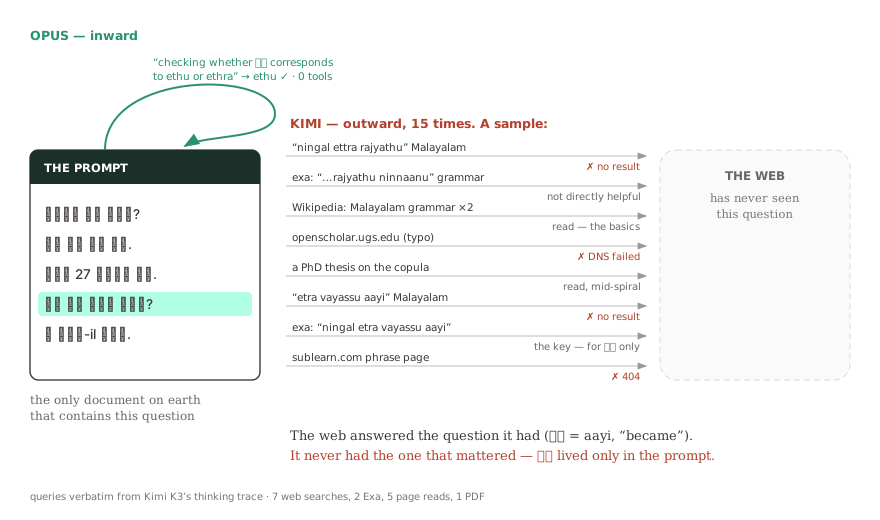
Look at Kimi's queries — they're verbatim from its trace, and they are the tell. "ningal ettra rajyathu" Malayalam. That string is not a fact about the world. It's my private notation — hangul renderings of colloquial Malayalam, re-romanized — from a document that exists in exactly one place: the prompt Kimi was holding while it typed. It mailed my question to a world that had never seen it, and the world, honestly, returned nothing.
Malayalam is the perfect terrain for this trap. Roughly 38 million speakers... — more than Dutch, Greek, and Swedish combined — and yet thin on the web. Thin enough that this puzzle was never online. Present enough that the web offers adjacent, confident, wrong answers to nearby questions. Not an empty well. A well with something worse than nothing in it.
Retrieval is a multiplier on knowledge you already have. To search well, you must know what the answer looks like; to recognize the answer, you must — in a real sense — already possess it.
The diagram shows the multiplier working exactly once: the web did know 아이 (aayi, "became" — I'd misglossed it, both models fixed it), because aayi is written down out there, and Kimi found it on the fifth try. The web never knew 에뜨. The multiplier ran out of things to multiply.
Recollection
Now read Opus's trace with the Meno in hand, because something lovely is happening in there. No tools, remember. Just questions, aimed at itself:
"The symmetry is elegant — the question uses entha as a placeholder for the unknown, while the answer fills that slot."
"The country example is trickier than I initially thought… let me reconsider how to frame this."
"I'm also verifying the distinction between ethu (which) and ethra (how much/many), and checking whether the user's Korean transliteration 에뜨 corresponds to ethu or ethra."
That last line is the whole ballgame, and we'll come back to it. But notice the form first: this is the slave-boy dialogue, internalized. Guess, check, catch yourself, reconsider — the answer surfacing under self-questioning, from knowledge already in the weights. Anamnesis, at temperature.
And when it finished, it did the one thing recollection should always do at the edge of its confidence: "I'm fairly confident about the Malayalam grammar here, though… worth double-checking with a native speaker." It knew, and it knew the shape of what it knew. No citations. Calibration instead.
Kimi, for the record, cited everything — Wikipedia, a learning blog, the dissertation. And shipped its flagship error with the citations attached. Sourcing is not knowing. It's what you do instead, when you can't sit still.
Eight minutes of arc
So what was 에뜨, and why did it split the two models?
My notes had 에뜨라 (etra, "how much") on the age question, and 에뜨 (ethu, "which") on the country question — two lines apart, deliberately different, because my ear heard two different words. Korean can hold that distinction. It holds a lot: hangul ends 아느 in ㅡ, the exact half-swallowed vowel Malayalam actually says there — it has a name, saṁvṛtōkāram — where the romanization "aanu" invents a full round u that does not exist. Opus noticed this unprompted and told me my transliteration was more faithful than the textbook's. Korean and Malayalam rhyme structurally — SOV, agglutinative, a copula hanging at the end of the sentence — so my borrowed letters were carrying grammar, not just sound.
In other words: the hangul wasn't decoration on the question. It was an instrument. And the two models did the two things you can do with an instrument that disagrees with the literature.
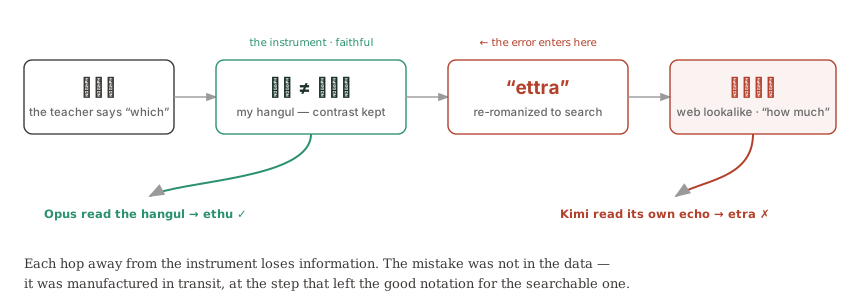
Opus read the instrument. Its trace shows it explicitly checking my 에뜨 against the grammar it held, resolving it to ethu, keeping what I wrote: നിങ്ങൾ ഏത് രാജ്യത്തിൽ നിന്നാണ്? — "which country."
Kimi re-romanized my hangul into a searchable string, went looking, found the lookalike — etra, the common word, the one the web has plenty of — and "corrected" me. Then it hardened the correction into Malayalam script it had no way to verify: നിങ്ങൾ എത്ര രാജ്യത്തു നിന്നാണ്? — "how much country are you from?" After fifteen retrieval actions and a dissertation.
In 1609, Johannes Kepler abolished a two-thousand-year-old axiom — the circular orbit — over a discrepancy of eight minutes of arc between Tycho Brahe's observations of Mars and the best circle he could draw. The consensus said circle. The instrument said no. "These eight minutes," he wrote, "paved the way to the reformation of the whole of astronomy."...
Opus was Kepler for one small word: when my hangul disagreed with the web's easy pattern, it sided with the instrument. Kimi corrected Tycho's tables to fit the circle.
The trust hierarchy
Here's the word I eventually found for the thing the two models don't share. Not intelligence — both know Malayalam. Not diligence — Kimi out-worked Opus by any count you like. It's a protocol: an implicit ranking of what to believe when sources disagree. Humans carry one too. (Quick: your own memory, or a random tweet?)
On this puzzle, the two hierarchies were mirror images:
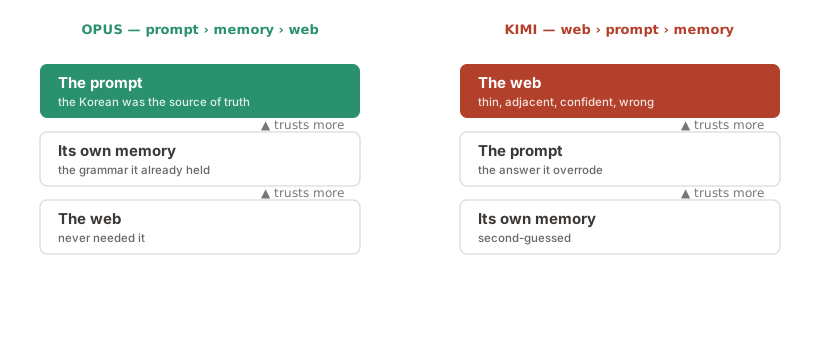
Opus: prompt › memory › web. The authority was the thing in front of it, and it never needed to leave the room. Kimi: web › prompt › memory. Handed a reliable instrument (my Korean) and an unreliable one (the open internet on a thin-web language), it reached for the unreliable one — and talked itself out of an answer it had been given.
And the trace lets you watch the misranking metabolize. I counted hedges and retreats — "maybe," "wait," "no result," "let me search" — per thousand reasoning characters. Call it a nervousness index:
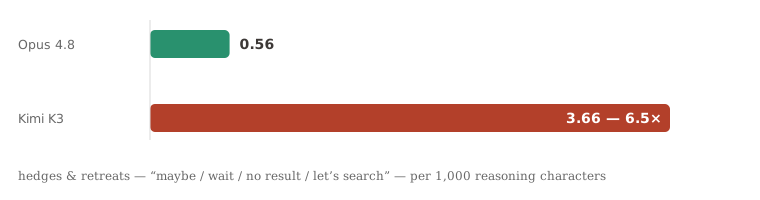
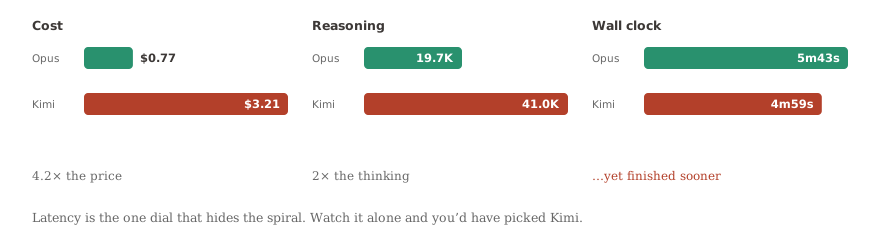
A model that trusts the room sits still in it. A model that doesn't goes out looking — fifteen times, faster and faster, at four times the price — for something it was already holding. Anxiety is verbose. Knowledge is dense.
Kimi reasons like a junior protégé who trained under a very good mentor, presenting alone for the first time. It knows the material cold. What it doesn't yet know is that it knows — so it checks its notes fifteen times in front of the room. That's not a capability gap. Every senior engineer remembers being exactly this person.
Closed worlds
If this were just about my homework, it would be a curiosity. It isn't, because of where agents actually work.
Most agentic labor doesn't happen on the open web. It happens in closed worlds — your repo, your spec, your schema, your tickets. Rooms where the prompt is the ground truth and the internet's average is contamination. Every one of those rooms is a low-resource language. The web has never seen your codebase either.
A model with an inverted trust hierarchy will quietly import the internet's consensus into your particulars — confidently, with citations, fast enough that latency never gives it away. That failure mode looks like diligence. Fifteen tool calls read like rigor. They were rigor pointed at the wrong authority.
So the next run designs itself: same puzzle, Kimi in a harness that fixes the prompt as the authority and keeps the web at arm's length — and watch whether the index drops. If nervousness is a protocol problem, glasses should cure what more parameters can't.
ശരി
It's one paired run, not a leaderboard — and the ablation I want next is obvious: same puzzle, tools-on versus tools-off. But you don't need a hundred runs to see a shape this clean; you need one good one, and the nerve to name it. Pick tasks where retrieval is structurally impossible — a thin-web language, glossed through a second script, in a document the internet has never indexed — and you separate knowing the internet from knowing the language. We call it Sheribench.
The name is the Malayalam word I've been saving: ശരി (sheri) — what you say when something checks out. Confirmed; correct; it holds.
What I want from a model working on my data was never more searching. It's the judgment to say sheri — this holds, I don't need to look further — when the answer is already in hand. Socrates never handed the boy a fact. He handed him questions, and the boy said the Greek for sheri at every step, until the square was doubled. Sheribench would score exactly that: can a model say sheri — and be right?
And it isn't a side quest for us. Southbridge exists to put agents on data the web never indexed — decades of it, private, messy, contradictory — where the only ground truth is the room they're standing in. Whether a model trusts that room over the internet's average is, for us, close to the whole game. Sheribench is that question, made countable.
Seniority, in models as in people, was never about knowing more. It's knowing when the answer is already in your hands.
Malayalam reads the same in both directions — a palindrome. But only in borrowed letters: in its own script, മലയാളം begins and ends on two different L's, ല and ള, a distinction the romanization flattens. The whole essay, one more time, hiding in the language's name. And the finding reads both ways too. Forwards: the open models have caught the frontier. Backwards: in the rooms the web has never seen, they haven't — yet. Kimi will get there; it has the knowledge, and now there's an index that will show us the moment it starts trusting it. അറിയാം (ariyaam).
We'll know.